
Fifteen thousand people came. Whose list are they on?
Your ticketing platform knows your buyers. It doesn't know the crowd — the plus-ones, the walk-ups, the people who drove three hours for one set. StageOwn captures the room itself, stage by stage, and the list belongs to you.
It's built and it's running — the Lone Star Roundup demo above is the real product with sample data, no account needed.
Every act on the bill. Not just the one with a sponsor.
The tools that capture fans at live shows today are deployed per artist, usually funded by a brand sponsor riding along in the data. That's why their own case studies are single headline tours — it's built for the act big enough to be worth sponsoring, not for the 2pm opener on the small stage. StageOwn is deployed once, by the festival, across every stage before gates open — so the whole bill is captured the same way, sponsor or not.
Based on publicly available information as of 2026. Per-artist capture tools (e.g. SET.Live) are deployed by individual artists and funded by brand sponsorship, with no festival-side product to give the organizer a lineup-wide, festival-owned list.
Put the lineup in. The codes do the rest.
A code on every stage
Each stage gets its own QR. It already knows who's playing there at that minute, so a fan scans and lands on that act — no menu, no typing, no wrong-band mix-ups.
One scan, three lists
That single tap adds the fan to the artist's list, the festival's list, and the venue's if the grounds are one. Nobody re-enters anything. Everyone owns their own copy.
Who actually drew the crowd
Because the scan is attributed to a set, you finish the weekend knowing which acts pulled people in — not who you assumed did. That's next year's lineup, with receipts.
Every stage on one screen.
While the festival is running: who's on each stage, how far into their set they are, how many fans they've captured, and which stage is pulling hardest right now. Explore it yourself — no waitlist.
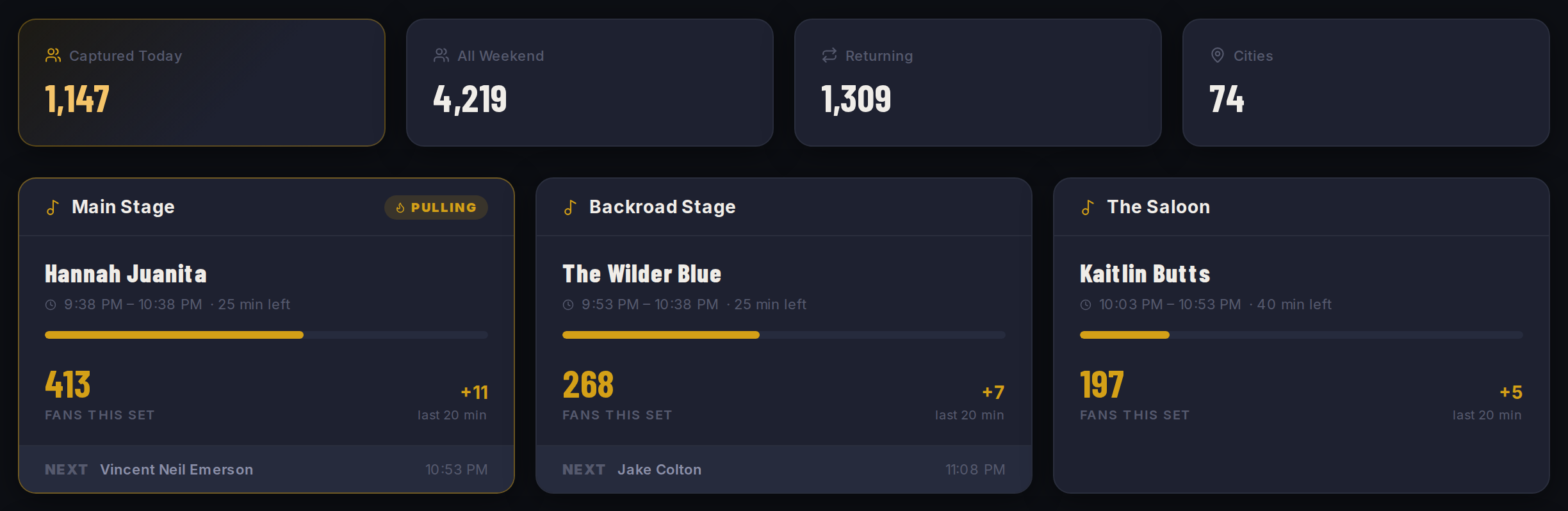
That's a screenshot of the running product, not a mockup.
Who drew the crowd?
Every scan is attributed to the set it happened at. Sunday morning, you have a ranked list of which acts actually pulled — and what that's worth at next year's negotiation.
The undercard that outdrew the headliner is the single most useful thing a festival can learn about its own weekend — and it never shows up in ticket sales.
Own the weekend, not just sell it.
The list is yours, not your ticketer's
Ticketing platforms hold the buyer data and rent it back to you. The people who scanned at your festival are in your account, exportable, forever — including the ones who came on a friend's ticket and never bought one at all.
The bill says yes because they get paid in fans
Enter a band's email on the lineup and we send them a link: "247 people joined your list at your set." They claim it free and keep those fans forever. You keep your copy. That's a real perk to put in the offer — and it's why acts actually announce the code from stage instead of ignoring it.
Where your crowd actually lives
City-level data across the whole weekend tells you where to spend promo, which markets to route next year, and what to show a headliner's agent when you make the case.
Set times drive everything
Put the lineup in once — artist, stage, start, set length — and the stage codes resolve themselves all weekend. No one is backstage swapping QR codes between sets.
An afternoon, not an integration.
Add your stages — each one gets a permanent QR you can print on the banner.
Enter the lineup: artist, stage, start time, set length. That's the whole schema.
Print the stage codes. Put them wherever people stand — rails, bars, wristband tents.
Watch every stage fill in live from one screen while the gates are open.
Export everything Monday. It's a CSV, it's yours, and nobody can take it back.
No hardware, no app for fans to download, no change to how you sell tickets.
Your next weekend, on your own list.
Festival Mode opens to a small first group for the 2026 season. We build your stages and lineup with you before gates open — and the earliest festivals help shape what it becomes.
Tell us your dates and stage count. We reply to every request.